
One claim per task
Claiming is atomic. The board holds the lock, so parallel agents never collide.

A task board for coding agents
breakaway is a task board for you and your coding agents: they claim the work, you merge it.
Paste this into Claude Code, and it sets up your board with you:
Set up a breakaway board for me. Read https://leavethepack.dev/install.md and follow it.Free to run. Free to change. For personal and noncommercial use.
How it works
Add tasks with a description and what done means, or write an idea and let an agent shape it into a spec and tasks.
A claim is atomic, so two agents never work the same task. Start Claude Code cloud agents from the board, or let local agents pick up work through the CLI, the MCP server, or the Claude Code plugin.
A pull request that says Closes BRK-12. puts the task in review. The task is done when you merge it.
An agent that needs you sends a ping to your inbox. The rest waits on the board.
What’s in it
Claiming is atomic. The board holds the lock, so parallel agents never collide.
Start Claude Code cloud agents on tasks, cap how many run at once, and watch their output live on the task.
See each pull request’s checks and reviews on its task, read the diff, and merge from the board.
Write an idea in your own words. Answer an agent’s questions in a form. Get a ping when only you can help.
Say what you want to make. The board walks you through a private repository and its agents, an agent asks plain questions, and you merge its plan.
Read a repository’s specs beside their tasks and refine one with an agent. Group tasks into features on a roadmap, and chase one.
Save an agent run and start it by hand, on a schedule, or on a GitHub event. Each run is a task.
Each repository has its own areas, prompt, and agents. Work that spans two is a task in each.
The web board, which installs on a phone, a CLI, an MCP server, and Taskwarrior sync. One set of data.
The tasks skill, /breakaway:next, the session hooks, and the board’s MCP server in one install, for you or every session in a repository.
An agent moves a repository to breakaway’s deploy flow in a pull request you merge. Then promote, roll back, and release its npm package from the board.
Releases never deploy themselves. Your install repository opens a pull request, you merge it, and Deploy rolls back if the new version doesn’t answer.
Architect · new in 2.0
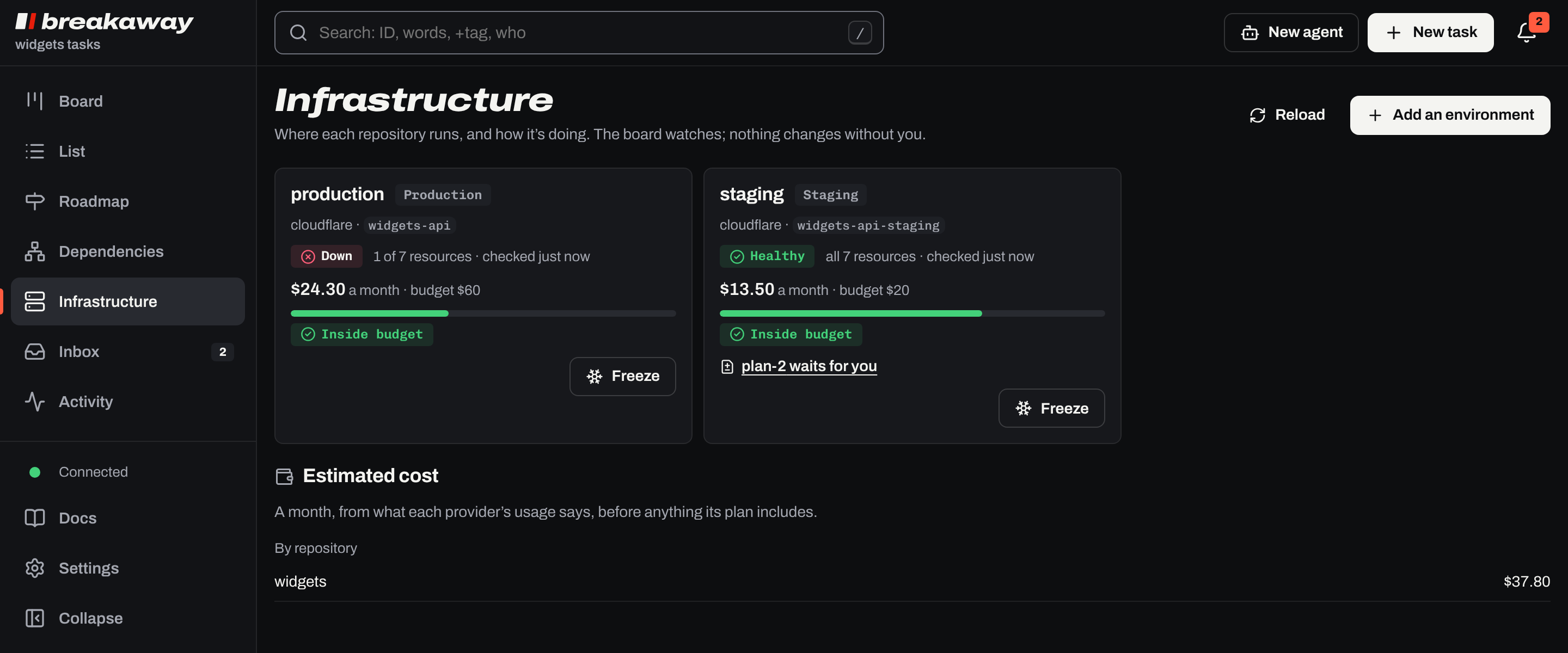
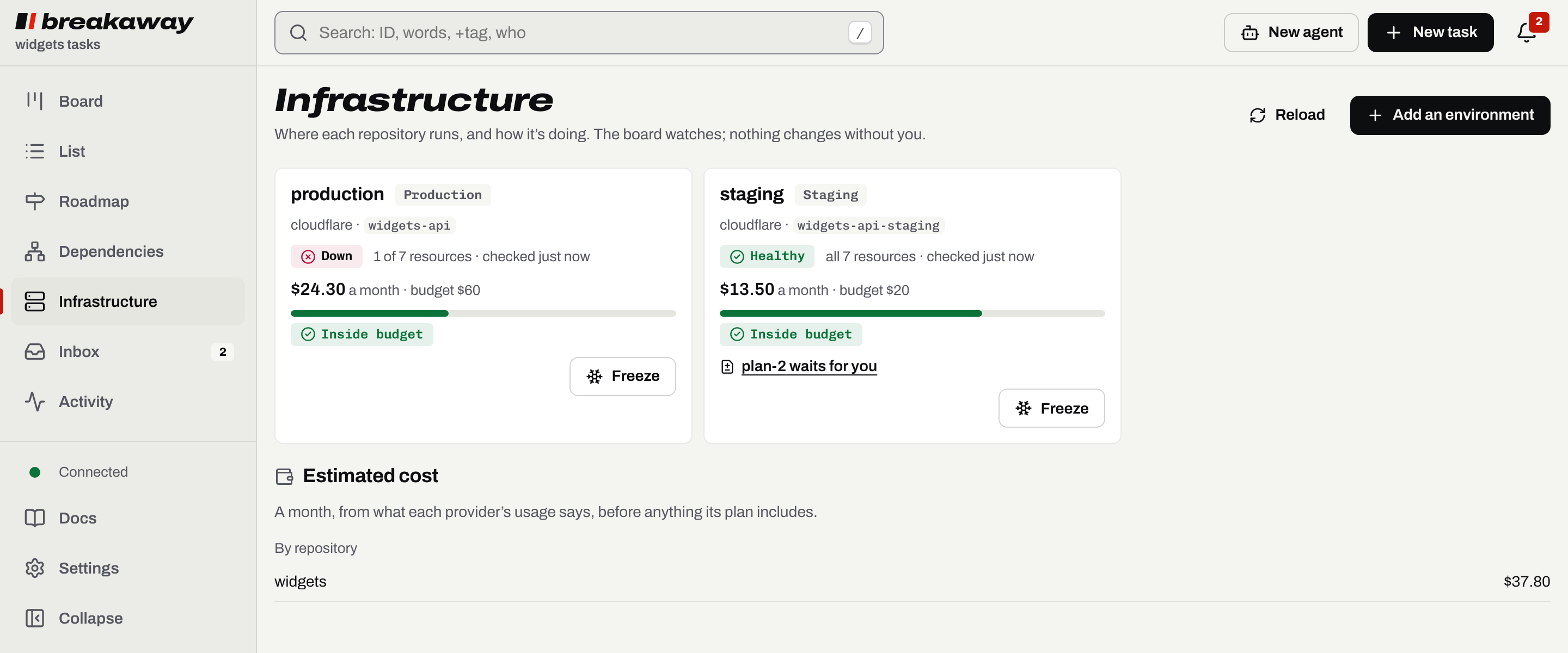
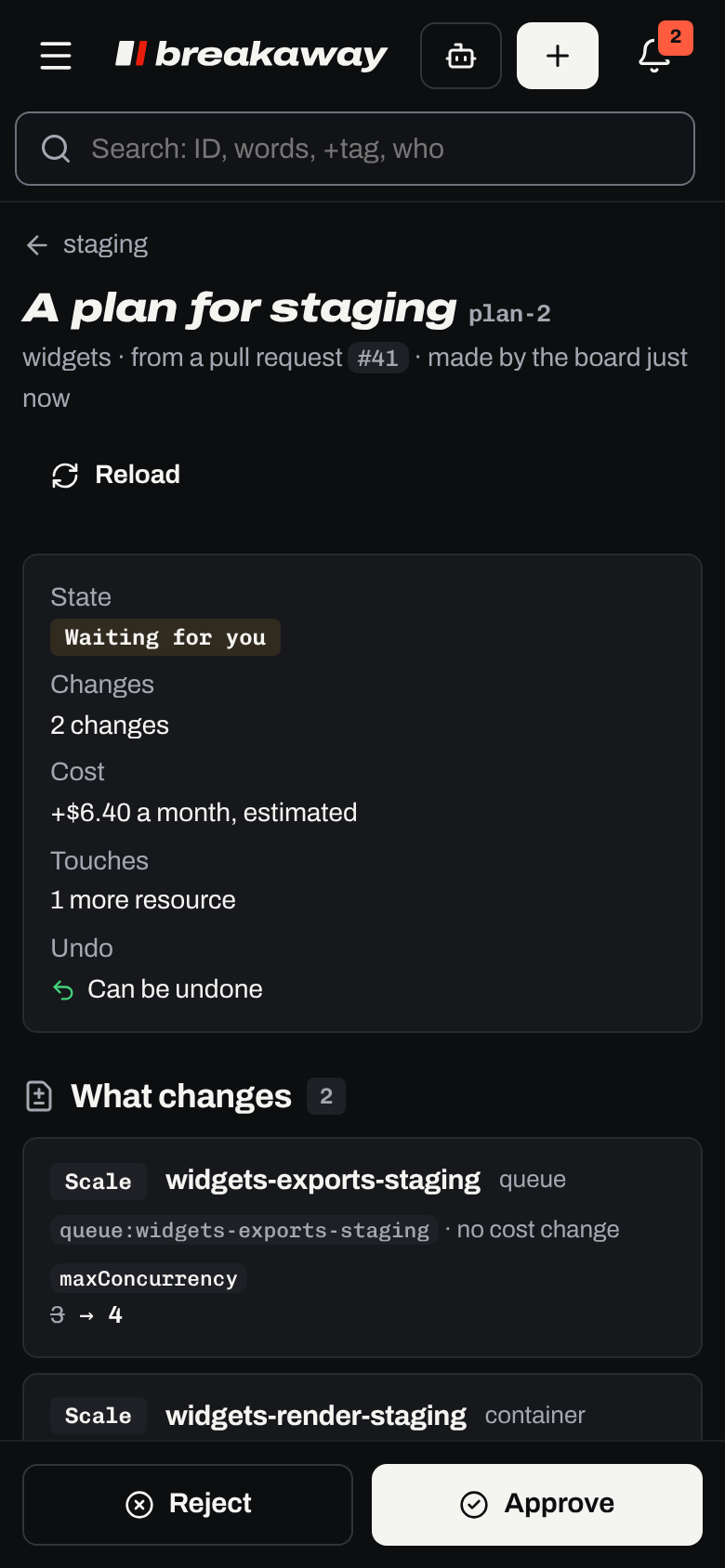
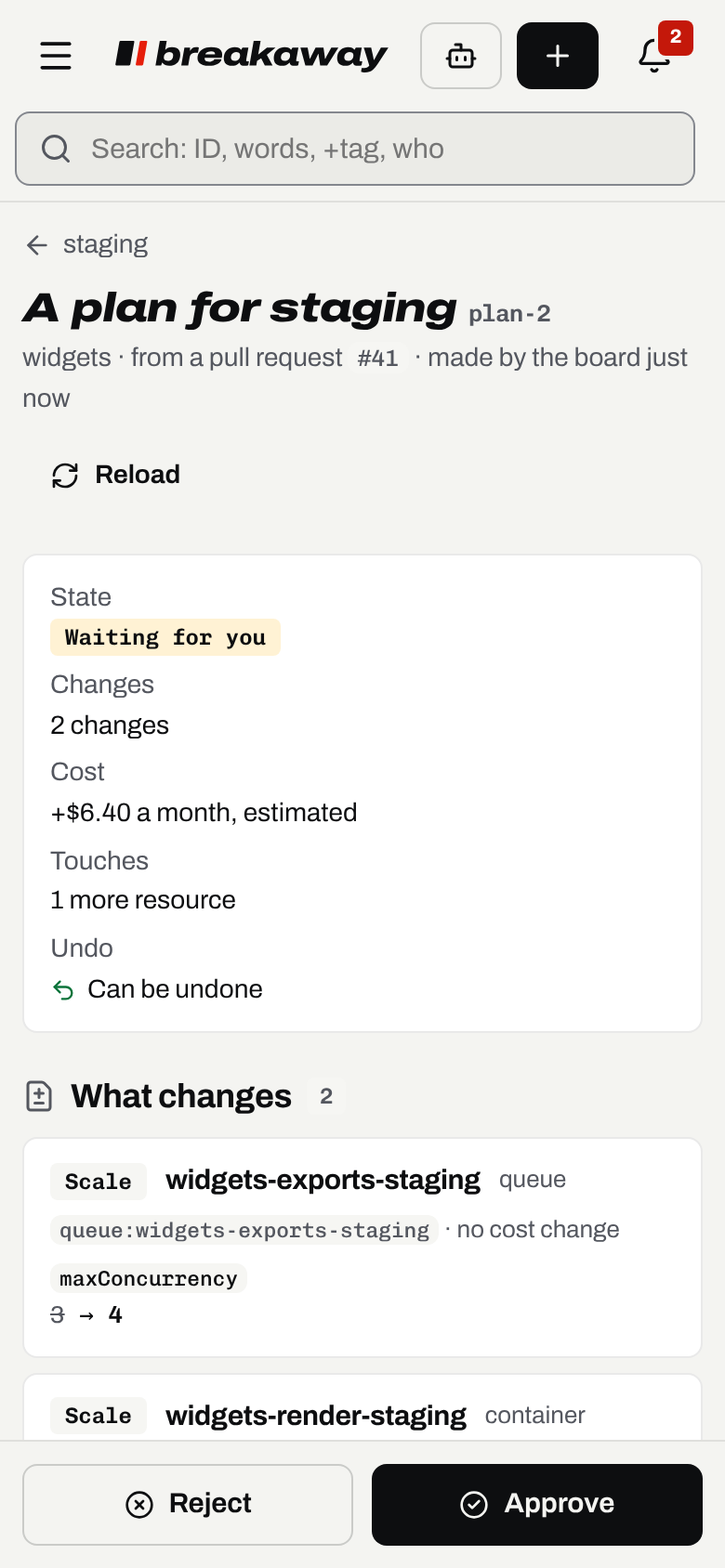
From the idea to what it runs on, one board. Connect Cloudflare with a read-only token, and the board shows each repository’s environments: what runs, its health, and what it costs. Agents change what should exist in a pull request, and the plan waits for you on your phone. You approve; the board applies it, checks health, and rolls back if the check fails.
Chase and the peloton
Group tasks into a feature, aimed at a release. Press Chase, and the board starts an agent on every ready task in it, and on what blocks it, until each one is done or in review. The agents of a chase check in on its peloton: what they’ll touch, what they did, and who goes first on a shared file.
MCP
Every board is an MCP server at /mcp. Add it to the coding agent in your terminal, your editor, or a chat app, and it lists, claims, and comments on tasks with tools, without the CLI. The board’s MCP page has the address to copy and a config to paste.
tasks skill, and /breakaway:next.{
"mcpServers": {
"breakaway": {
"type": "http",
"url": "https://board.example.com/mcp",
"headers": {
"Authorization": "Bearer ${BREAKAWAY_TOKEN}",
"X-Breakaway-Agent": "my-agent",
"X-Breakaway-Repo": "widgets"
}
}
}
}Four ways in
Agents anywhere use the CLI, including cloud sessions, or connect Claude Code to the board’s MCP server at /mcp. You use the web board on your laptop or your phone. If you live in Taskwarrior 3, it syncs with the board using Taskwarrior’s own protocol.
In Claude Code, breakaway’s plugin brings it all in one install: claim with /breakaway:next, hand over with /breakaway:hand-over. claude.ai and Claude Desktop sign in to /mcp with a connection you approve on the board.
The CLI reference, the Claude Code plugin, MCP clients, the web board, and Taskwarrior.
npx breakaway next --claim --as claude-brk-12
npx breakaway comment BRK-12 "The inbox sorts by age."
npx breakaway ping BRK-12 --kind blocked \
  "Needs the DNS record added in the dashboard."
npx breakaway list --ready

task sync
task agent    # ready for an agent
Run your own
breakaway runs on your own Cloudflare account: a Worker and a Durable Object. An install repository holds its settings and the workflows that deploy and update it. Paste one line into Claude Code and it sets up your board with you, stopping for each step only you can do. Or follow the guide’s nine steps by hand: each ends in a check.
With Claude Code, in an empty folder:
Set up a breakaway board for me. Read https://leavethepack.dev/install.md and follow it.Or by hand:
mkdir my-board && cd my-board
git init
npx breakaway install init

# push it to a private GitHub repository,
# then run its Deploy workflow
npx breakaway init-secrets
What it isn’t
The road ahead
Planned, and the plan changes. This is a snapshot of breakaway’s own roadmap, taken from its board when it moves. Each release marks itself out once it ships.
2.0.0 Next
The board runs your infrastructure too, on Cloudflare: environments from nothing, a console, and policy. Agents propose changes in pull requests; you approve the plans, and they run in your own GitHub Actions.
Free for personal and noncommercial use, under the PolyForm Noncommercial License 1.0.0. Commercial use is by exception, granted free and case by case.
Plan a feature’s start and end, and see from the pace when it’s likely done.
2.1.0 Planned
A road captain for each chase, and chases sized to what you can review.
People and roles inside your own install, so a group can run one board together, each with their own agents. You still decide what merges and deploys, and there’s still no hosted version.
2.2.0 Planned
Habits for every agent: review its own work, answer what it’s asked, and check its sources.
Compliance checks on your code and infrastructure, software bills of materials, and a data inventory, from the board.
A routine that reads the board’s own activity and flags an agent working out of line.
2.3.0 Planned
Inference APIs as something Architect runs, with keys, budgets, and usage, and agents on more than one model.
A name, a voice, a look, a site, and launch posts for each repository. Agents draft; you choose and publish.
2.4.0 Planned
Runners on your own compute that take the board’s jobs: apply runs, CI, and later agents.
Everything from an idea to what runs, versioned and connected: checks and builds bound to the exact code, and a trail from anything running back to its idea.
2.5.0 Planned
Providers after Cloudflare, one at a time, each checked end to end before the next.
2.6.0 Planned
Metrics, logs an agent can read during an incident, and traces, redacted before they reach the board.
2.7.0 Planned
Architect plans through OpenTofu, so any platform with a provider there can be an environment.
2.8.0 Planned
A repository for each claimed task on Cloudflare Artifacts, with its changes, checks, and a preview on the board.
3.0.0 Planned
Host the code on your install too, with reviews and checks built for many agents at once. GitHub stays supported.
breakaway works with Claude Code, GitHub, Taskwarrior, and Cloudflare. None of them made it or endorse it.